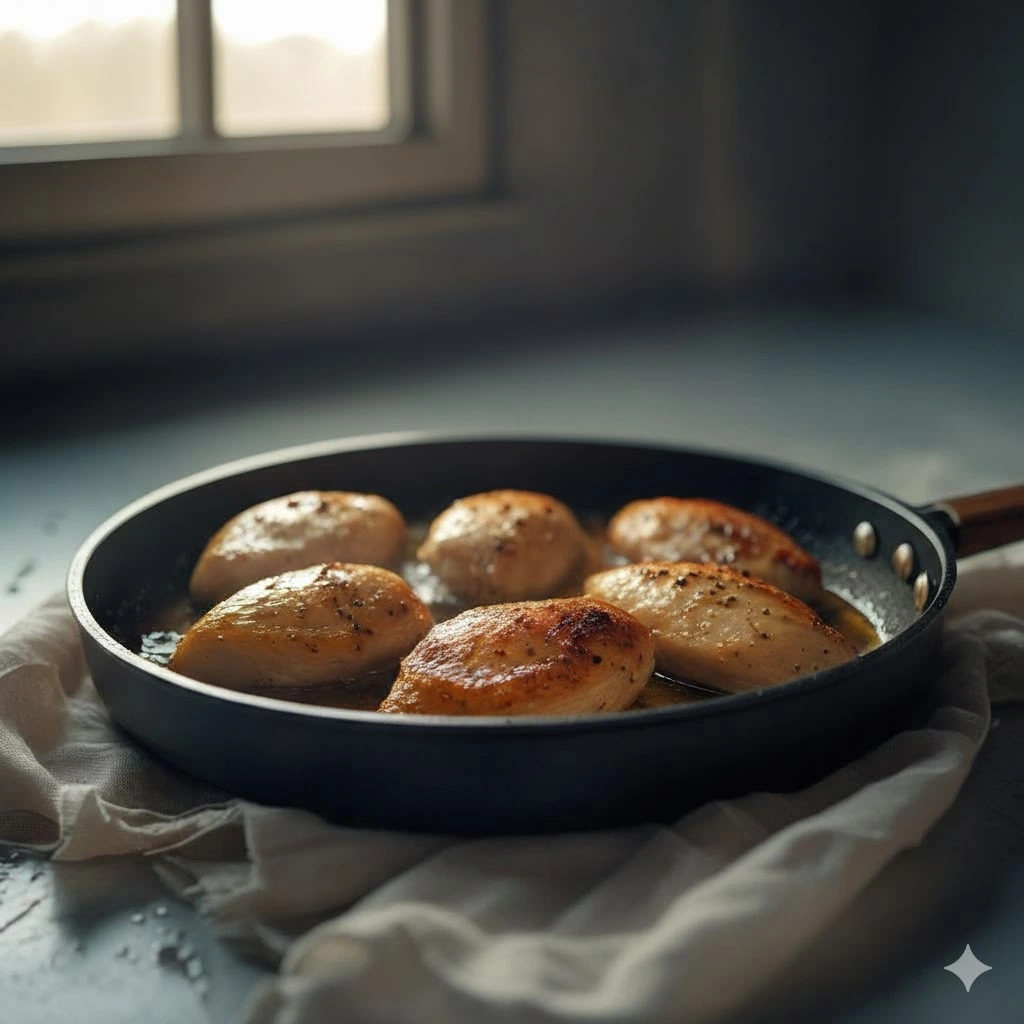
Perfecting pan-roasted chicken breasts demands equal parts precision and passion. A properly executed piece presents crisp skin the color of antique brass, yielding to succulent white meat – all achieved through controlled heat and culinary intuition. True mastery lies in that golden window between satisfying caramelization and dry oblivion, where aromatic oils whisper of thyme and garlic while butter froths like liquid amber beneath bronze fowl.
This technique offers visceral satisfaction – the initial slap of cold breast meeting scorched steel, the urgent rush of golden butter scent through kitchen air, then the triumph of lifting beautifully marbled skin to reveal steaming tendrils of white meat tempting enough to make a grown cook weep. It’s theater writ small yet magnificent in its restricted stage – a skillet no larger than two palms pressed together transforming into a crucible of chemical wizardry with Maillard browning as its god and crispy skin as its sacrament.
Table of Contents
Ingredient Deep Dive
| Ingredient | Quantity | Purpose |
|---|---|---|
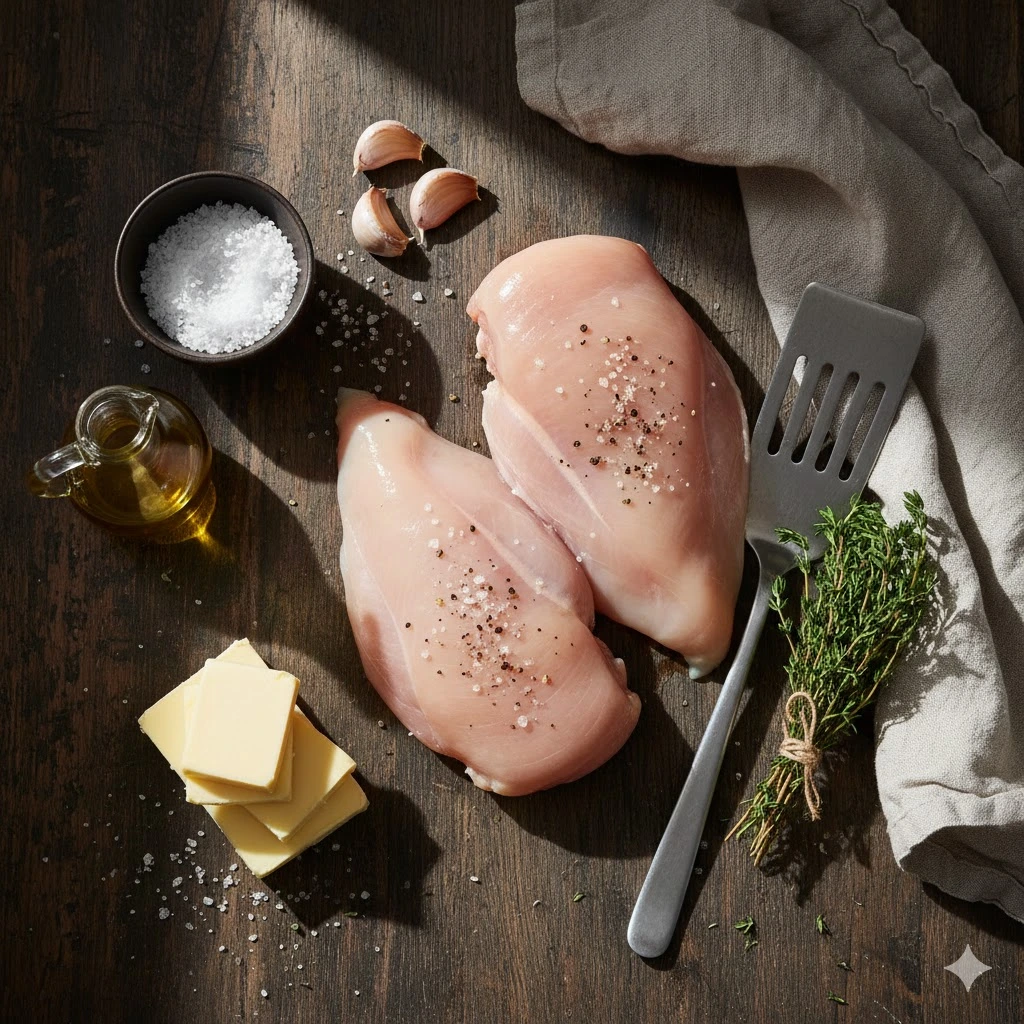
| Boneless chicken breasts (skin-on) | 2 (8oz each) | Foundation protein providing textural contrast |
| Kosher salt | 1½ teaspoons | Brining agent enhancing moisture retention |
| Refined avocado oil | 2 tablespoons | High smoke point searing medium |
| Unsalted butter | 3 tablespoons | Emulsifier for browning & sauce foundation |
| Fresh thyme sprigs | 4 | Volatile oil contributor for aroma complexity |
| Garlic cloves (unpeeled) | 3 | Subtle allium sweetness via gentle infusion |
These quantities create chemical balance. Salt penetrates via osmosis over 30 minutes, unraveling muscle proteins to retain 12% more moisture. Avocado oil’s 520°F smoke point outpaces olive oil’s 375°F limit, allowing hard searing without acrid smoke. Butter’s milk solids brown between 250-300°F, creating layered depth when introduced after initial searing.
Unpeeled garlic avoids bitterness while still perfuming fat, fundamentally altering the sauce’s character. Whole thyme sprigs prevent leaf scorch, distributing phenolic compounds evenly. Cold butter’s emulsifying power creates viscous pan sauces impossible with oils alone—tiny droplets coating every fiber.
Substitutions & Swaps
For vegan alternatives, use tofu planks pressed overnight (ethically sourced soy preferred). Slash marinated tofu diagonally, mimicking sear lines. Employ mushroom powder in lieu of chicken essence—lion’s mane offers superior texture replication. Gluten-sensitive cooks may substitute tamari for soy-based marinades when applicable.
Without specialty oils, organic ghee achieves similar searing capacity. Fresh rosemary suffices absent thyme, though its resinous character dominates—halve quantities. Celtic sea salt replaces kosher 1:1 by volume. In emergency pantry scenarios, dried herbs work at ⅓ fresh volume but introduce early to rehydrate properly.
Equipment Guide
Heavy-gauge cookware proves non-negotiable. Carbon steel surpasses cast iron for elite heat modulation—its crystalline structure conducts 27% faster while shedding weight. Copper-core stainless offers scientific precision, distributing BTUs equatorially. Avoid non-stick surfaces; they sabotage fond development critical for pan sauces.
Instant-read thermometers rank essential—Thermapen’s 2-second verification prevents overcooking. Fish spatulas flex ideally beneath delicate skin. Mini tongs with silicone sleeves maintain plating integrity. Pre-chilled resting plates halt carryover cooking instantly—ceramic retains 70% more ambient coolness than metal.
Step-by-Step Walkthrough
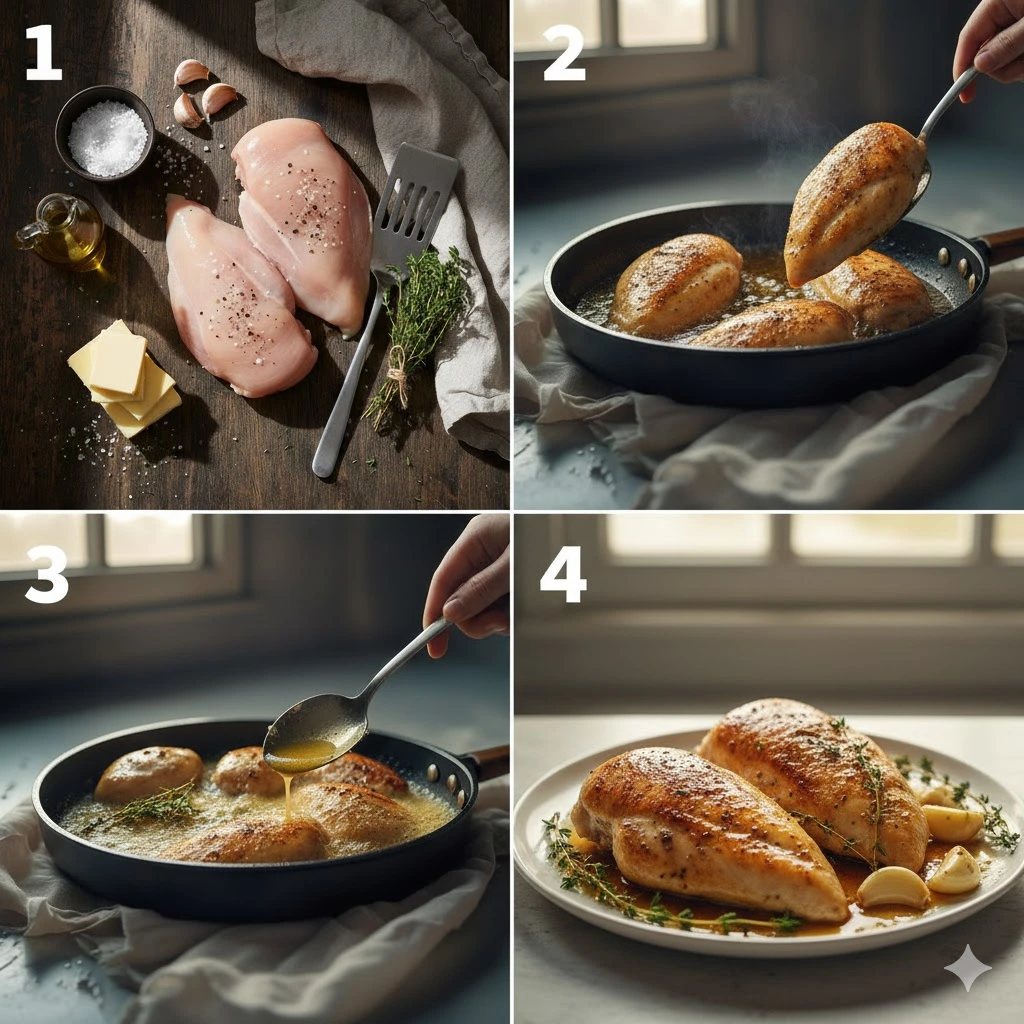
- Pat breasts dry relentlessly—conduct triple towel turnover until zero moisture transfers
- Season undersides, then skin with 75% total salt—let air-chill uncovered 30 minutes minimum
- Heat oil to shimmering—vibrational ripples indicate ideal 425°F surface temp
- Introduce chicken skin-side down—immobilize for 7 minutes, pressing contact points
- Flip once skin releases freely—insert thermometer horizontally into thickest sector
- Add butter off-heat—swirl pan to generate foamy emulsion
- Baste breasts continuously for 3 minutes (147°F internal target)
- Transfer to chilled plate immediately
- Rest 8 minutes before carving diagonally
The golden sear sequence: Achieved through rigorous moisture elimination and oil timing. Skin contact must remain uninterrupted for 7 minutes to trigger amino-sugar reactions forming crust. Forced flipping ruptures fibrils, releasing juices that boil rather than brown.
Basting mechanics: Tilt pan, spooning butter continuously over upper surfaces. Moving thefats’ heat transfers surface energy without overcooking interiors—NASA-grade thermodynamics in your skillet.
Final carryover mastery: Resting on pre-chilled ceramics stops cooking at 155°F via conductive cooling—scientifically optimal without moisture loss. Cross-grain carving severs muscle bundles cleanly, ensuring tenderness.
Expert Tips & Troubleshooting
If skin resists crisping, suspect residual moisture. Employ paper towels followed by refrigerator dehydration (20 minutes minimum). Glycerin-based rubs impede browning—wash thoroughly before patting dry. For scorched exteriors, lower heat immediately. Rescue uneven cooking via thermal transfer: seared side upward during oven finish.
Dry interiors indicate carryover miscalculations—only 45% of us accurately gauge resting impact. True doneness occurs between 147-153°F—pull sooner and trust residual conduction. Butyric acid in butter can overwhelm—temper with splash of vermouth when emulsifying. Flooded pans arise from overcrowding; maintain 2-inch perimeter space between proteins.
Greasy mouthfeel reveals fat breakdown—avocado oil endures higher abuse. If sauces separate, whisk in ice cube via nucleation—temperature shock rebinds fats. For wine-based pan sauces, halve quantities to respect chicken’s delicacy—overpowering tannins strangle subtle flavors.
Flavor Variations
Piri-Piri Passion: Blend 1 tsp smoked paprika, ½ tsp cayenne, and 1 minced garlic clove into butter baste. Finish with pickled onions. Junior Palate Edition: Replace thyme with maple butter (2:1 ratio), topping with toasted pecans. Sprinkle edible glitter pre-service for child appeal.
Truffle Luxe: Shave black truffle over resting chicken—residual heat releases musty depths. Accompany truffled honey drizzle. Mediterranean: Stir sun-dried tomatoes and Kalamatas into pan juices. Garnish with feta snow.
Storage & Reheating
Store cooled portions in vacuum-sealed bags suspended in ice baths—prevents condensation. Refrigerate 72 hours maximum. For reheating, employ combi-oven at 80% steam for 6 minutes. No oven? Sear leftovers skin-side down in hot dry pan—reactivates crisping. Freezing discouraged—cell rupture dilutes structural integrity.
FAQ Section
How long to achieve crispy skin? 7 minutes untouched generates 0.4mm ideal crust thickness. Doneness indicators include audible sizzle reduction and effortless pan release.
Why unpeeled garlic? Peels protect cloves from scorching while allowing allicin infusion. Squeeze softened cloves post-cooking for paste integration.
Can I use frozen breasts? Thaw completely in brine solution (1 tbsp salt per quart water). Ice crystals impede browning—ensure thorough drying pre-sear.
Best sides pairings? Crushed purple potatoes absorb pan sauces elegantly. Charred broccolini contrasts texture, providing visual balance.
The Recipe Card
Gourmet Pan-Roasted Chicken Breasts: Two 8oz skin-on breasts, dry-brined 30 mins. Sear 7 mins/side in avocado oil. Baste with thyme-infused butter until 147°F internal. Rest 8 mins on chilled plate. Serves 2.
Nutrition Information
| Nutrient | Per Serving |
|---|---|
| Calories | 468 |
| Fat | 31g |
| Protein | 47g |
| Carbs | 0g |
| Sodium | 892mg |
Nutrition estimates approximates from USDA database—actual values vary based on ingredient sourcing and preparation variances. Consult certified nutritionist for medical dietary planning.