
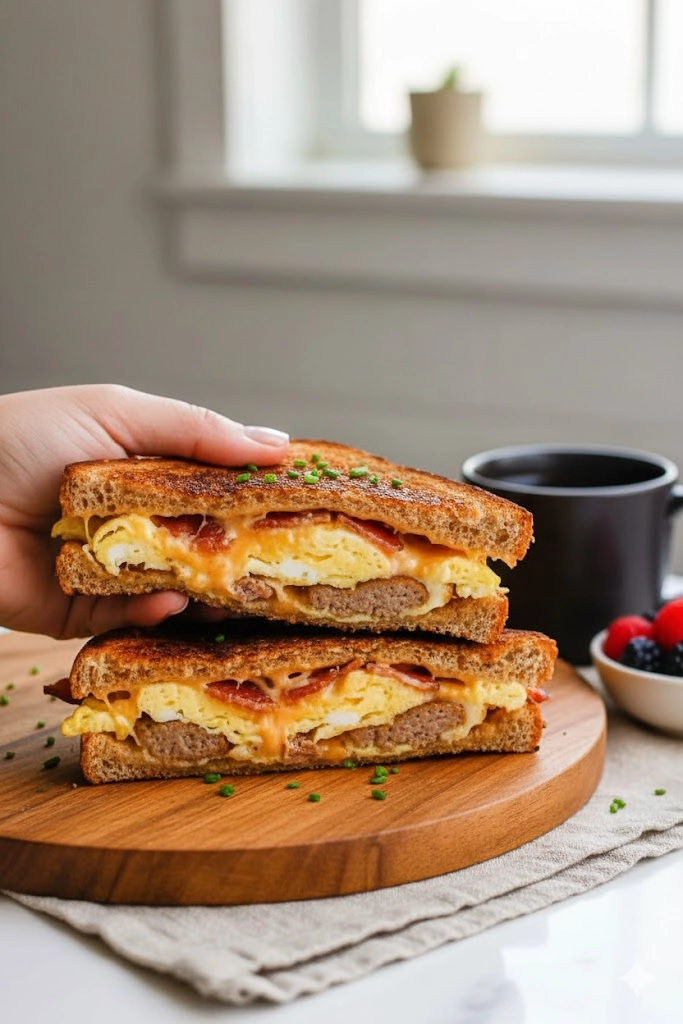
This article provides a refined, technical approach to preparing the Breakfast Grilled Cheese, transforming a simple diner classic into a perfect, sophisticated handheld meal. This sandwich is celebrated for its harmonious blend of creamy cheese, fluffy eggs, and savory meats, creating a deeply satisfying texture and flavor profile. It’s an excellent choice for a hearty weekend brunch or a substantial weekday breakfast that requires minimal fuss but delivers maximum flavor impact.
Ingredients
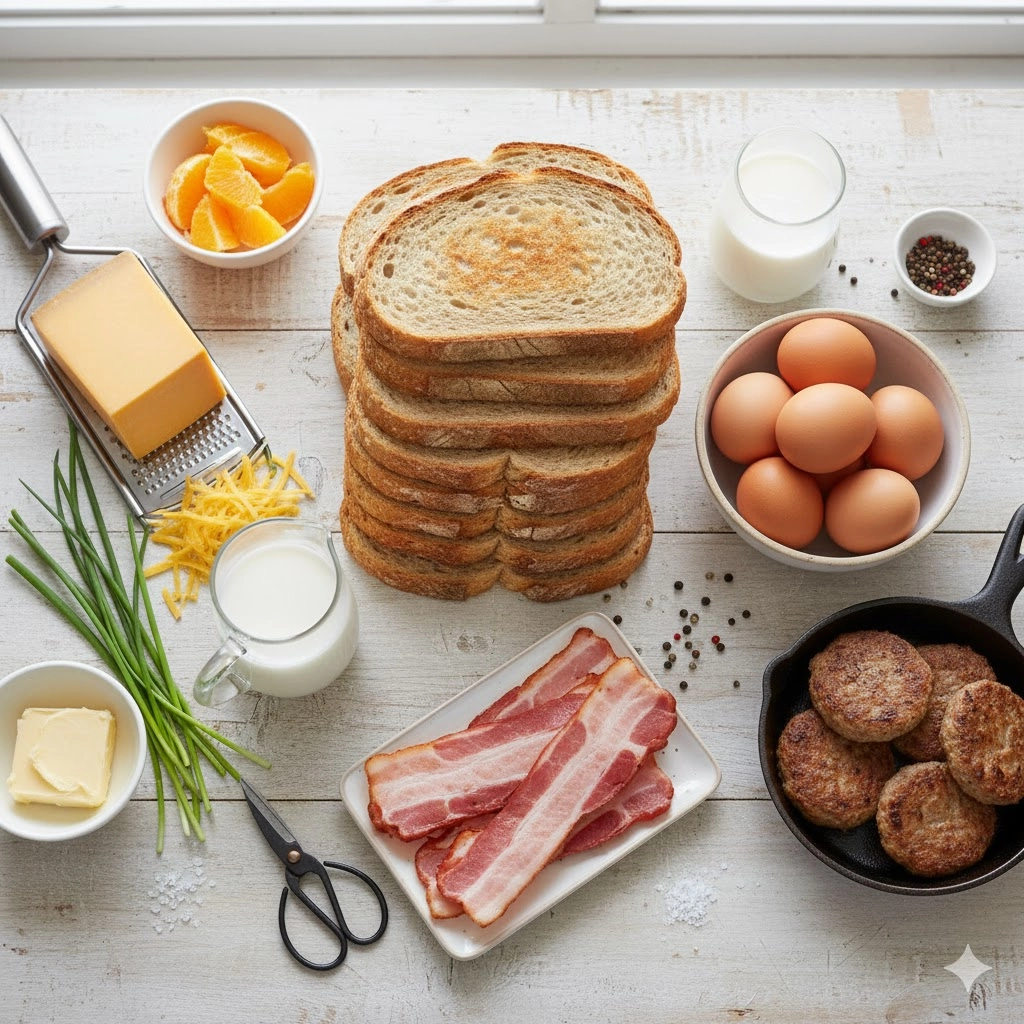
Egg and Protein Components
- 8 large eggs
- $1/4$ cup (60 ml) milk or cream
- $1/2$ teaspoon kosher salt
- $1/4$ teaspoon freshly ground black pepper
- 4 strips of bacon, cooked until crisp and drained
- 4 ounces (113 g) cooked sausage crumbles or thin breakfast sausage patties
Assembly Components
- 8 slices of hearty bread (Sourdough, Texas Toast, or Brioche work well)
- 4 tablespoons (56 g) butter, softened, divided
- 8 slices of cheese (sharp cheddar, Monterey Jack, or provolone)
- 2 tablespoons chives, fresh, finely chopped (optional garnish)
Instructions
- Prepare the Eggs: Whisk eggs, milk, salt, and pepper in a medium bowl until frothy. Melt $1/2$ tablespoon of butter in a nonstick skillet over medium-low heat. Pour in the egg mixture and cook for 5–7 minutes, gently moving the scramble until a soft consistency is achieved. Remove from heat.
- Butter the Bread: Spread softened butter evenly on one side of all 8 slices of bread.
- Heat the Pan: Preheat a large nonstick or cast-iron skillet over medium heat (or use a griddle).
- First Toast: Place 4 slices of bread, butter-side down, onto the hot skillet. Cook for 2–3 minutes until lightly golden brown. Remove these 4 slices and set aside.
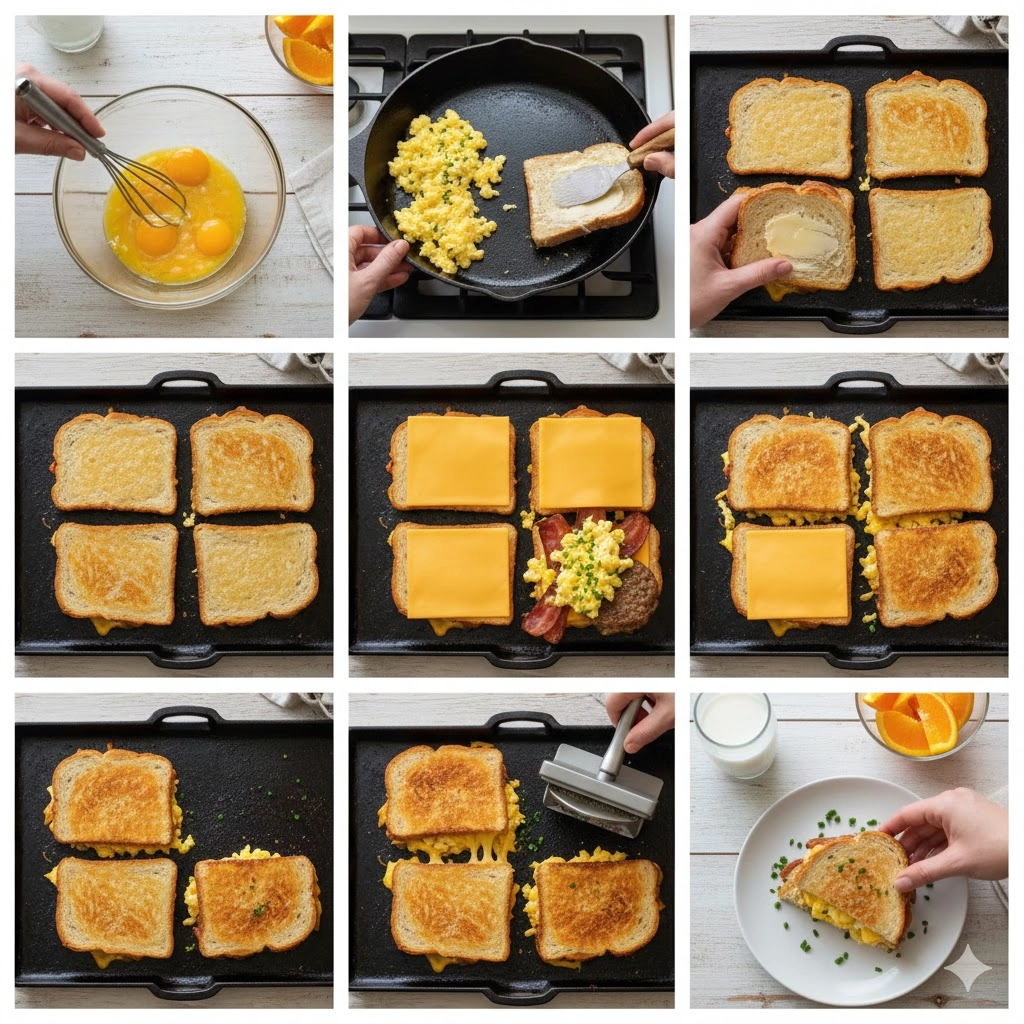
- Assemble the Sandwich Base: Place the remaining 4 slices of bread, butter-side down, on the skillet. Immediately top each slice with one slice of cheese.
- Layer the Fillings: Distribute the scrambled eggs, cooked bacon, and sausage equally across the four slices topped with cheese.
- Add Final Cheese Layer: Top the meat and egg mixture on each sandwich with a second slice of cheese.
- Close and Grill: Place the 4 lightly toasted slices of bread (from Step 4) on top, butter-side up. Grill for 3–5 minutes per side, turning carefully, until the bread is deep golden brown and the cheese is fully melted.
- Serve: Remove from skillet, slice diagonally, and serve immediately, optionally garnished with chives.
The Science of the Perfect Melt: A Technical Breakdown
Achieving the ideal Breakfast Grilled Cheese relies on thermal management—specifically, maintaining a heat gradient that crisps the exterior bread without scorching it, while delivering enough radiant heat to thoroughly melt the cheese and warm the interior fillings.
Scrambling Technique for Sandwich Integration
The goal for the egg component is a soft, slightly moist scramble. Because the eggs will receive a secondary heating cycle within the sandwich, they should be removed from the skillet just before reaching full firmness. This technique prevents rubberiness. The small amount of milk or cream added to the eggs is crucial; the fat content helps keep the protein strands tender, ensuring the final filling is rich and not dry.
Optimal Heat and Fat Application
The exterior of the sandwich requires a moderate, steady heat source. A medium heat setting on the stove is generally appropriate. This temperature avoids the Maillard reaction (browning) occurring too quickly. The softened butter applied to the bread exterior serves two roles: it provides fat for flavor and color, and its moisture content helps regulate the surface temperature, resulting in a uniform golden crust. Using softened, not liquid, butter ensures a continuous layer, which translates to even browning across the entire surface.
Thermal Efficiency and Assembly Order
The assembly process is designed for optimal thermal transfer.
- Bottom Cheese Layer: Placing the first slice of cheese directly onto the bottom slice of bread establishes a crucial moisture barrier. As the cheese melts, it adheres to the bread, preventing the egg and meat fillings from making the bread soggy.
- Middle Load: The eggs and meats are placed in the center. It is imperative that these fillings are not densely packed, which would inhibit heat penetration.
- Top Cheese Layer: The second slice of cheese acts as the binding agent for the top slice of bread.
- Covering Technique (Optional): If the internal fillings are cold, briefly covering the skillet with a lid during the final grilling phase creates trapped steam. This gentle, moist heat accelerates the melting process of the cheese and warms the fillings without risking the external crust becoming too dark.
Enhancing Quality and Consistency
Ingredient Standardization
Consistency is paramount when preparing a filled grilled sandwich. Use slices of cheese that are roughly the same size and thickness to ensure they melt at the same rate. For the bread, select a variety with high structural integrity, such as sourdough or Texas Toast, which will not compress excessively under light pressure and can contain the dense fillings without tearing.
Precision in Protein Preparation
All meats (bacon and sausage) must be cooked completely, cooled slightly, and thoroughly drained of excess fat. Residual grease will leach into the bread, resulting in an oily, unappealing texture. Patting the cooked bacon strips or sausage crumbles with paper towels before assembly is a recommended step for fat removal.
Utilizing Pressure for Adherence
To achieve a flat, cohesive sandwich unit, gentle, even pressure should be applied during the grilling process. A clean, weighted object—such as a small skillet or a dedicated sandwich press—can be placed on top for the initial two minutes of grilling. This facilitates the rapid fusion of the melted cheese with the bread and the fillings, ensuring the sandwich holds together when sliced.
Practical Adaptations
Component Modification
If a lower fat content is desired, the eggs can be substituted with an equivalent volume of liquid egg whites. Note that this requires the addition of a small amount of liquid fat (like a teaspoon of olive oil) during the scramble to prevent a tough texture.
Flavor Customization
To introduce complexity, consider incorporating acidic elements. A very thin layer of tomato paste or a small amount of finely minced, caramelized onion spread on the interior of the bread can cut through the richness of the cheese and egg. Alternatively, a smoked cheese, such as smoked Gouda, can replace the standard cheddar to impart a distinct wood-smoke flavor.
Scaling Production
For preparing a large batch (e.g., eight or more sandwiches), a large, flat electric griddle is significantly more efficient than a stovetop skillet. Maintain the heat setting at a consistent $300^{\circ}\text{F}$ ($150^{\circ}\text{C}$) to ensure simultaneous and uniform cooking across all units.
Pairing Recommendations
Due to the richness of the egg, meat, and cheese content, the Breakfast Grilled Cheese pairs best with sides that offer acidity, freshness, or a textural contrast.
- Acidic Counterpoint: A classic pairing is a cup of smooth, creamy tomato soup. The acidity of the tomato balances the fat content of the sandwich, creating a palatable contrast.
- Refreshing Side: A simple, vibrant fruit salad featuring berries and citrus sections (oranges or grapefruit) provides a light, cool, and highly refreshing element.
- Textural Supplement: A small serving of slightly crisp, seasoned home fries cooked with onion and bell pepper offers a desirable starchy crunch that completes the meal experience.
Nutritional Review
This nutritional data is an estimate based on the standard ingredients listed and represents one full serving (one sandwich).
| Nutrient | Amount per Serving |
| Calories | 645 kcal |
| Protein | 35 g |
| Carbs | 40 g |
| Fat | 40 g |
| Fiber | 3 g |
| Sugar | 6 g |
| Sodium | 980 mg |
Nutrition Disclaimer
Nutrition information is an estimate and may vary based on preparation and ingredients used.

Breakfast Grilled Cheese
Ingredients
- 8 large eggs
- 1/4 cup milk or cream
- 1/2 tsp kosher salt
- 1/4 tsp freshly ground black pepper
- 4 strips bacon, cooked crisp and drained
- 4 oz cooked sausage crumbles or thin patties
- 8 slices hearty bread (Sourdough, Texas Toast, or Brioche)
- 4 tbsp butter, softened, divided
- 8 slices cheese (cheddar, Monterey Jack, or provolone)
- 2 tbsp fresh chives, finely chopped (optional garnish)
Instructions
- Whisk eggs, milk, salt, and pepper in a bowl until frothy. Melt 1/2 tbsp butter in skillet over medium-low heat. Pour egg mixture in and scramble gently for 5–7 minutes until soft. Remove from heat.
- Spread softened butter evenly on one side of all 8 slices of bread.
- Preheat a large nonstick or cast-iron skillet over medium heat (or use a griddle).
- Place 4 slices of bread, butter-side down, on the hot skillet. Cook 2–3 minutes until lightly golden. Remove and set aside.
- Place remaining 4 slices of bread, butter-side down, on the skillet. Top each with one slice of cheese.
- Distribute the scrambled eggs, bacon, and sausage evenly over the 4 slices with cheese.
- Top each with another slice of cheese over the meat and egg.
- Place the toasted bread slices from Step 4 on top, butter-side up. Grill 3–5 minutes per side until golden and cheese melts.
- Remove from skillet, slice diagonally, and serve hot. Garnish with chives if desired.
Notes
Equipment
- nonstick skillet or cast-iron skillet
- mixing bowl
- whisk
- spatula
- bread knife