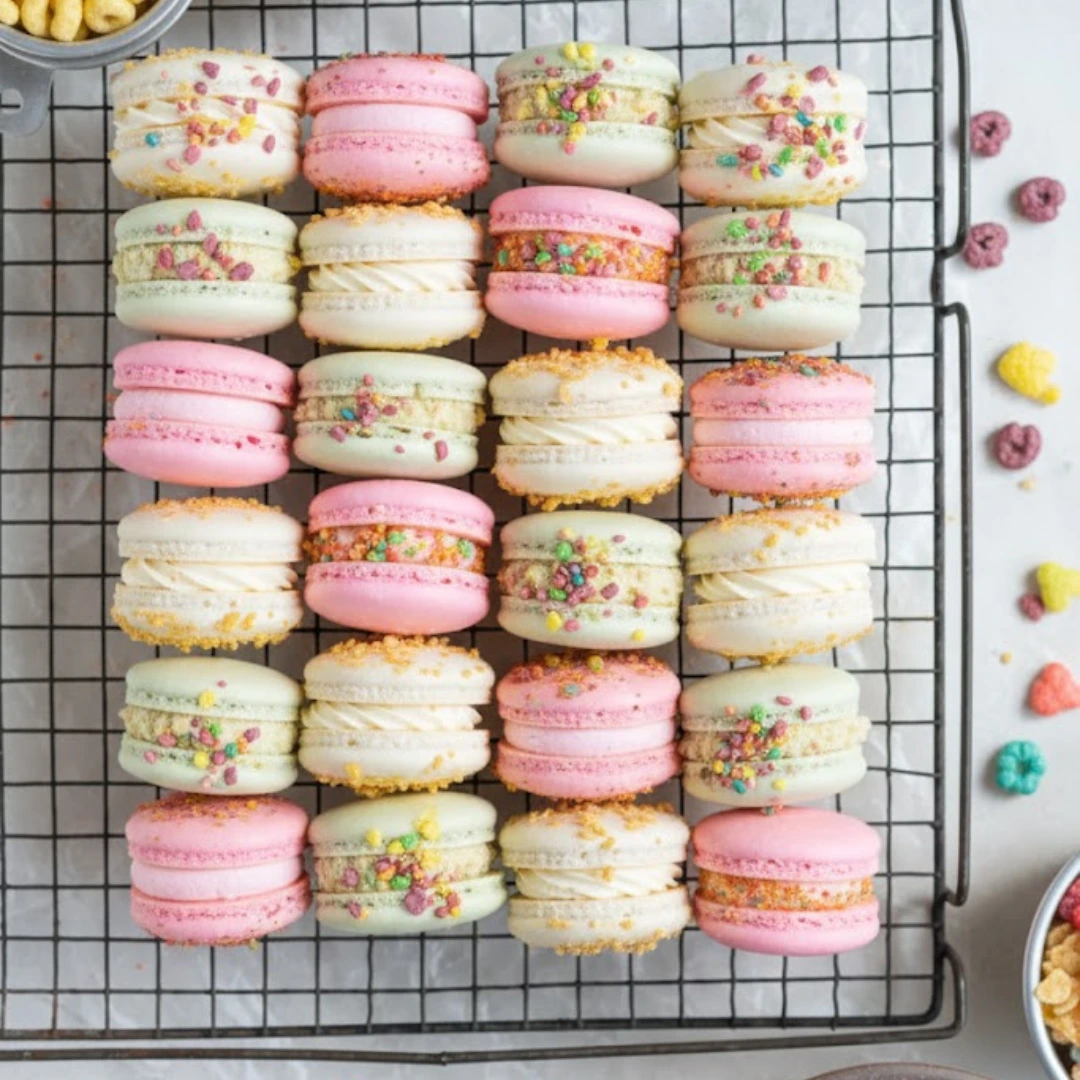
The magic of a Saturday morning breakfast meets the sophisticated elegance of French pastry in these incredible Lucky Charms Cereal Macarons. There is something deeply nostalgic about the taste of cereal milk—that sugary, toasted grain-infused liquid left at the bottom of the bowl once all the crunchy bits have been devoured. By capturing that specific essence and folding it into a silky German buttercream, we create a dessert that is both whimsical and high-end. Whether you are a seasoned macaron baker or a brave beginner, this recipe offers a playful twist on a classic technique, resulting in a vibrant, marshmallow-scented treat that looks as good as it tastes.
Table of Contents
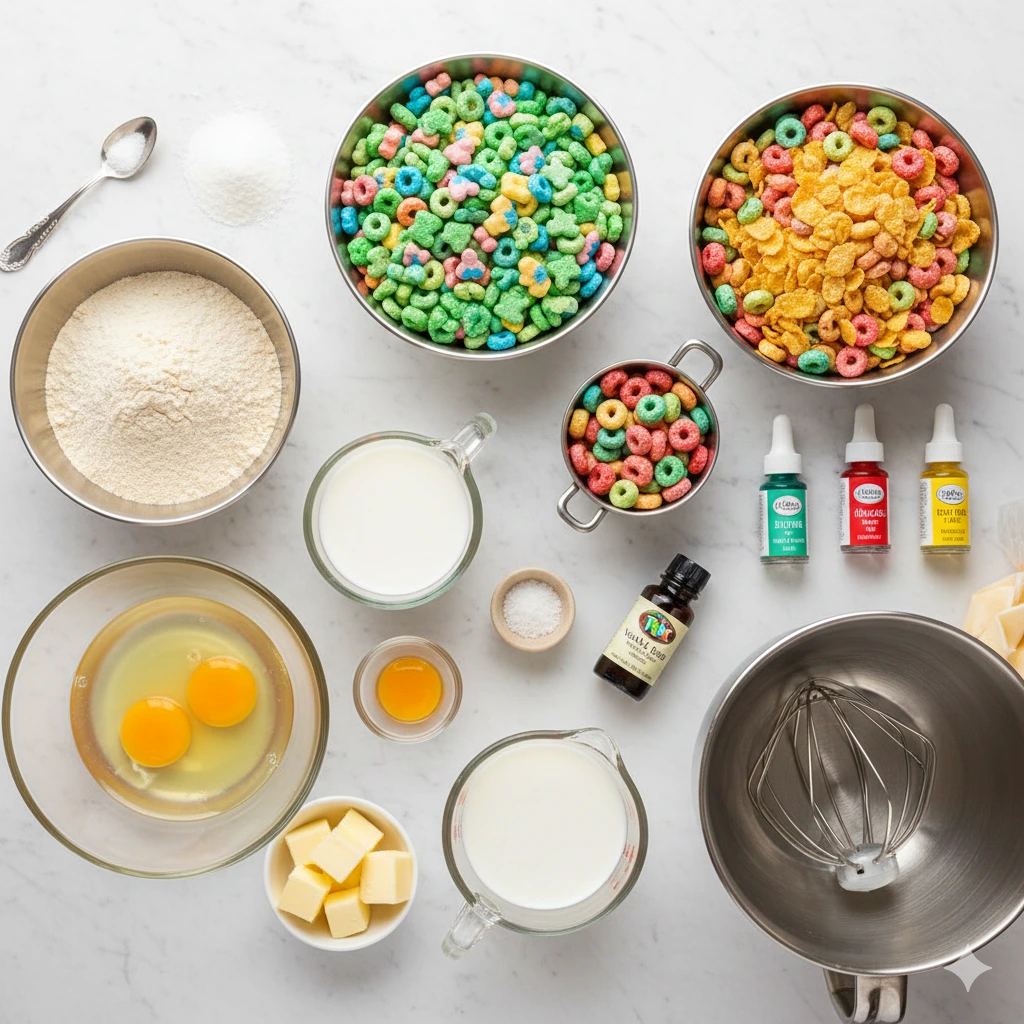
Ingredients for the Perfect Batch
To achieve that iconic meringue crunch and the rich, custardy filling, you will need to gather the following components. Precision is the soul of French pastry, so using a kitchen scale is highly recommended for these specific measurements.
For the Macaron Shells
- 170 grams ground almonds (fine almond flour)
- 300 grams powdered sugar
- 180 grams egg whites, at room temperature
- 160 grams sugar (granulated)
- A few drops of gel food coloring (Mint green or avocado green for the Lucky Charms aesthetic)
- 1 teaspoon vanilla bean paste
- Crushed Lucky Charms cereal to finish (optional for topping)
Cereal Milk German Buttercream
- 400 grams whole milk
- 75 grams Lucky Charms cereal (or Trix/Frosted Flakes for variations)
- 110 grams sugar
- 12 grams (1.5 tablespoons) corn starch
- 1 egg
- 1 egg yolk
- 0.5 teaspoon salt
- 1 teaspoon vanilla bean paste
- 340 grams unsalted butter, at room temperature
Master Instructions for Success
Preparing the Shells
Preheat your oven to 300 Fahrenheit and ensure the oven rack is positioned in the center for even heat distribution. Prepare your baking surface by using a round cookie cutter or the base of a large piping tip to draw a template on parchment paper. Aim for circles about 1.5 inches in diameter with at least 0.75 inches of space between them.
In a large bowl, combine the almond meal and powdered sugar. Sift this mixture twice. This step is non-negotiable as it removes large lumps and aerates the dry ingredients for a smooth shell.
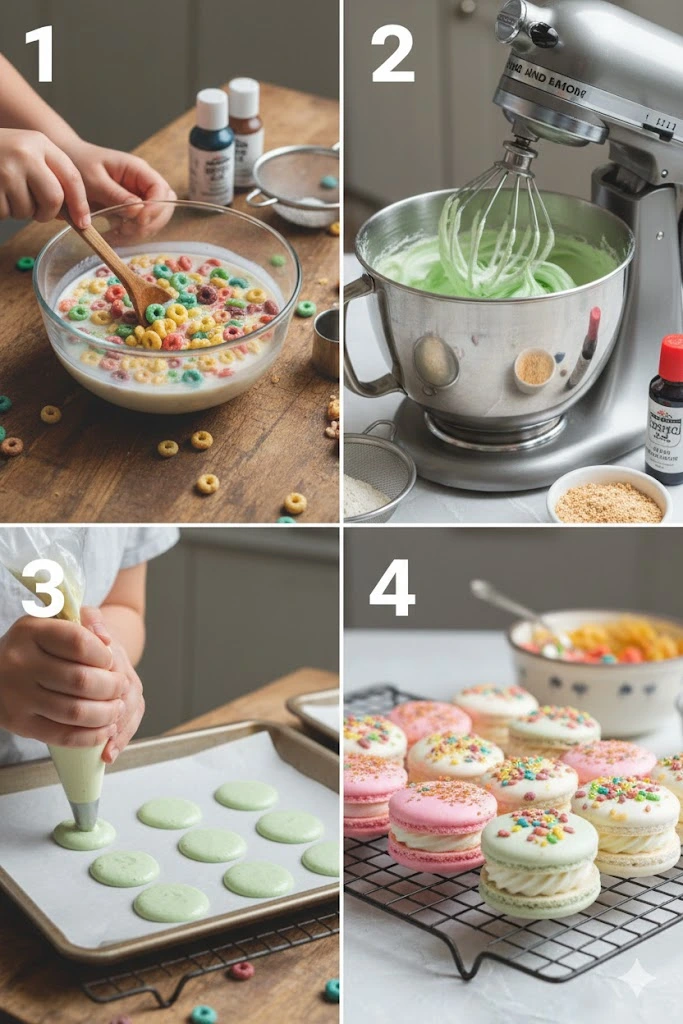
Using a stand mixer with the whisk attachment, whip the egg whites on medium speed until they become foamy. Gradually stream in the granulated sugar while increasing the speed to high. Once the meringue starts to firm up, add your gel food coloring and vanilla bean paste. Continue whipping until you reach stiff, glossy peaks.
Remove the bowl and fold in half of the almond/sugar mixture. Deflate the meringue slightly to incorporate. Add the remaining dry mixture and fold using the macaronage technique—spreading the batter against the side of the bowl and scooping from the bottom. Stop when the batter flows like lava and you can draw a figure 8 without the ribbon breaking.
Pipe the batter onto your prepared parchment using an Ateco 805 tip or similar. Bang the tray firmly against the counter to release air bubbles. Let them dry for about 30 minutes until a skin forms. Bake for approximately 18 minutes, using a second “doubled up” sheet pan underneath to prevent the bottoms from browning too quickly. Let cool completely before removing from the paper.
Crafting the Cereal Milk Filling
Begin by infusing 400 grams of milk with 75 grams of cereal in an airtight container for one hour at room temperature. Strain the mixture twice and weigh out exactly 190 grams of the resulting cereal milk.
Whisk together the sugar, corn starch, egg, egg yolk, and salt. Heat the 190 grams of infused milk and vanilla in a saucepan until just below a simmer. Temper the egg mixture by slowly pouring half of the hot milk into it while whisking constantly. Return everything to the saucepan and cook over medium heat, whisking until it bubbles and thickens into a pastry cream.
Cover the pastry cream with plastic wrap directly on the surface and chill until cold (at least four hours). To finish the buttercream, whip the chilled pastry cream until smooth, then gradually add the room-temperature butter a few cubes at a time. Whip until the mixture is light, airy, and stable.
Assembly
Match up shells of similar sizes. Pipe a generous dollop of the German buttercream onto one shell and sandwich with another. For the best texture, let these mature in the refrigerator overnight.
Deep Dive into the Macaronage Process
The heart of a successful macaron lies in the mixing, a process known as “macaronage.” This is where many bakers feel the most pressure, but understanding the science makes it much more manageable. When you first add your almond flour to the stiff meringue, the mixture will look clumpy and dry. Your goal is to systematically knock some of the air out of the egg whites while ensuring the dry ingredients are fully hydrated.
As you scrape the batter up the sides of the bowl and fold it back into the center, you are breaking down the large air bubbles. This creates the structural integrity needed for the “feet”—that ruffled bottom edge—to form. If you under-mix, the shells will crack in the oven because there is too much trapped air. If you over-mix, the batter will be too thin, and your macarons will spread into flat, hollow pancakes. The “lava” stage is the sweet spot; the batter should disappear back into itself after about 10 seconds of sitting.
Achieving the Ultimate Creamy Consistency
German buttercream is distinct from its American or Swiss cousins because it uses a custard base (pastry cream). This makes it significantly less sweet and much richer, which is the perfect vehicle for cereal milk. To ensure your filling is the smoothest it can be, the temperatures of your butter and your pastry cream must be nearly identical.
If the pastry cream is too cold, the butter will clump and the frosting will look curdled. If this happens, don’t panic. Simply take a hair dryer to the side of the mixing bowl for a few seconds or place the bowl over a pot of simmering water for 30 seconds to slightly warm the edges, then continue whipping. The mixture will eventually emulsify into a cloud-like consistency that holds its shape perfectly between two shells.
Essential Gear for Pastry Precision
Having the right tools can make the difference between a kitchen disaster and a bakery-quality result. Here is what I recommend for this specific recipe:
- Digital Kitchen Scale: Volume measurements for flour and sugar can vary by as much as 20 percent. For macarons, grams are the only way to go.
- Fine Mesh Sieve: This ensures your almond flour is powdery and light.
- Silicone Spatula: You need a flexible edge to properly “smush” the batter during the macaronage phase.
- Gel Food Coloring: Liquid coloring adds too much moisture to the meringue and can ruin the chemistry. Always use concentrated gels.
- Piping Bags and Tips: A steady hand and a round tip (like the Ateco 805) ensure your circles are uniform.
Flavor Variations and Color Styling
While Lucky Charms is the star of this show, the cereal milk technique is incredibly versatile. You can easily adapt this recipe to create a “Cereal Box Set.”
- Trix Version: Use deep pink gel food coloring for the shells and sprinkle the tops with crushed Trix. The citrusy notes of the cereal pair beautifully with the vanilla bean.
- Frosted Flakes Version: Keep the shells a natural cream color. Use a star tip (like the Ateco 867) to pipe the buttercream for a more textured look and roll the edges in crushed Frosted Flakes.
- Cocoa Puffs Version: Substitute a small portion of the powdered sugar (about 15 grams) with high-quality cocoa powder for a chocolatey shell that tastes like a mocha breakfast.
Proper Storage and Maturation Techniques
One of the greatest secrets of the macaron world is that they are actually better the next day. This process is called “maturation.” When the filled macarons sit in the refrigerator, the moisture from the buttercream slowly migrates into the shells. This softens the interior of the cookie while keeping the exterior crisp, creating that signature “melt-in-your-mouth” texture.
Place your assembled macarons in an airtight container and let them rest for at least 12 to 24 hours. If you need to store them longer, they actually freeze beautifully. You can keep them in the freezer for up to one month. Just be sure to thaw them in the refrigerator for a few hours before bringing them to room temperature for serving.
Troubleshooting Common Macaron Issues
Why did my shells crack on top?
Cracking usually happens for two reasons: either you didn’t let the shells dry long enough to form a skin, or your oven temperature is too high. The skin acts as a lid; when the steam expands inside the cookie, it’s forced out the bottom, creating the “feet.” If there is no skin, the steam just bursts through the top.
Why are my macarons hollow?
Hollow shells are often a sign of over-whipping the meringue or under-mixing the final batter. If the meringue is too dry, it creates large pockets of air that collapse during baking. Try stopping your mixer just as the peaks become stiff and stand upright.
Why do they stick to the parchment paper?
If the shells don’t peel away cleanly, they are likely underbaked. Give them another minute or two. However, if you’ve reached the maximum time and they still feel sticky, use the freezer trick: put the tray in the freezer for five minutes, and they should pop right off.
Frequently Asked Questions
Can I use liquid food coloring if I don’t have gel?
It is highly discouraged to use liquid food coloring in macaron shells. The chemistry of the meringue is very sensitive to moisture levels. Adding liquid can make the batter too runny, preventing the shells from drying properly or developing the necessary feet. If you must use it, keep it to one single drop, but for best results, stick with gel or powder.
How do I know when the milk has infused enough cereal flavor?
One hour is generally the sweet spot for infusion. You want the milk to take on the toasted, sugary profile of the cereal without the cereal turning into a complete paste that makes the milk too thick to strain. Shaking the container every 15 minutes helps move the fats around to pick up those flavor molecules more efficiently.
Why do I need to double up my baking sheets?
Macarons are very sensitive to bottom heat. If the bottom of the pan gets too hot, the shells can brown or the feet can spread outward too aggressively (known as “outturned feet”). By placing your baking sheet on top of a second, room-temperature sheet, you create a buffer of air that insulates the cookies and ensures a gentle, even rise.
What is the difference between German buttercream and regular frosting?
Traditional American buttercream is made by beating butter with powdered sugar. It is very sweet and can sometimes feel “gritty.” German buttercream uses a cooked custard (pastry cream) base. This results in a much more sophisticated, less sugary flavor and a texture that is silky and rich, similar to a dense whipped cream.
Nutritional Information
| Serving Size: 1 Macaron | Amount Per Serving |
| Calories | 165 |
| Total Fat | 11 grams |
| Saturated Fat | 6 grams |
| Cholesterol | 35 milligrams |
| Sodium | 65 milligrams |
| Total Carbohydrates | 16 grams |
| Dietary Fiber | 1 gram |
| Sugars | 14 grams |
| Protein | 3 grams |
Disclaimer
Nutritional values are estimates based on standard ingredient data. Actual values may vary depending on the specific brand of cereal and almond flour used.
A Final Thought on These Whimsical Treats
Baking macarons is as much a science experiment as it is a culinary art. These Lucky Charms Cereal Macarons take that challenge and turn it into something purely joyful. They represent the perfect balance of technical skill and childhood nostalgia. While the process requires patience—from the double-sifting of the flour to the overnight maturation in the fridge—the reward is a dessert that sparks conversation and brings a smile to everyone who tries one. So, put on your favorite apron, turn on some music, and enjoy the process of creating these tiny, magical pieces of pastry art.
Lucky Charms Cereal Macarons Sweet Treat
Ingredients
- 170 g ground almonds (almond flour)
- 300 g powdered sugar
- 180 g egg whites, at room temperature
- 160 g granulated sugar
- 2 drops mint green gel food coloring
- 1 tsp vanilla bean paste
- 400 g whole milk (for infusion)
- 75 g Lucky Charms cereal
- 110 g granulated sugar (for buttercream)
- 12 g corn starch
- 1 large egg
- 1 large egg yolk
- 0.5 tsp fine sea salt
- 1 tsp vanilla bean paste (for buttercream)
- 340 g unsalted butter, room temperature
Instructions
- Sift almond flour and powdered sugar twice. Whip egg whites to a foam, gradually add sugar, and whip to stiff peaks. Add vanilla and green food coloring.
- Fold dry ingredients into meringue using the macaronage technique until batter flows like lava and can form a figure 8.
- Pipe 1.5-inch circles onto parchment. Bang trays to remove air bubbles. Let dry for 30 minutes until a skin forms.
- Bake at 300 degrees Fahrenheit for 18 minutes. Cool completely on a wire rack before peeling from paper.
- Infuse milk with cereal for 1 hour; strain and keep 190g. Whisk egg, yolk, sugar, and starch in a bowl.
- Heat milk, temper into egg mixture, then cook until thickened. Cover with plastic wrap and chill until cold.
- Whip chilled pastry cream until smooth, then gradually add butter cubes until light and fluffy.
- Pipe buttercream onto shells and sandwich together. Store in the fridge overnight to mature.
Notes
Equipment
- Digital Kitchen Scale Crucial for macaron success
- Stand Mixer With whisk attachment
- Piping Bag with #805 Round Tip
- fine mesh sieve
- silicone spatula
- heavy-bottomed saucepan